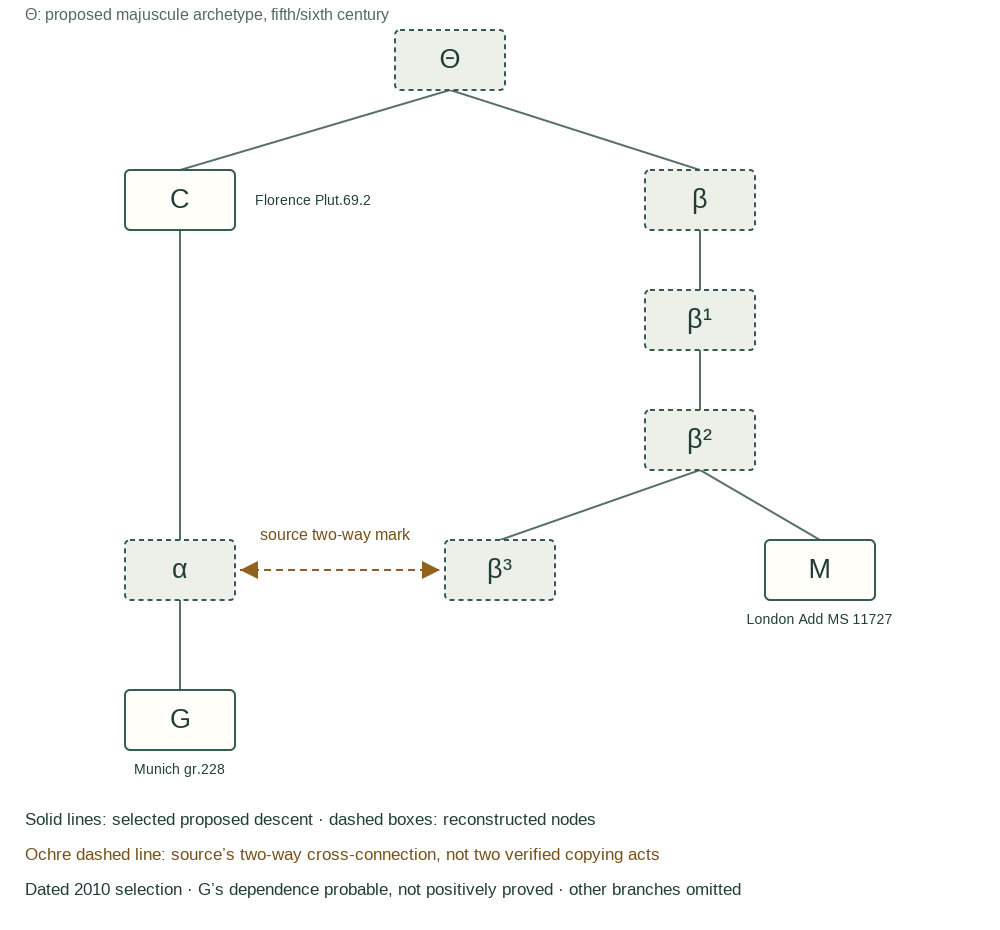
The2010 article rethinks the archetype and G’s relation to C. Read this selection beside the dated 1972 and 2000 models, then follow checked Munich image samples.
Eight solid lines reproduce selected descent paths from the 2010 source figure; one ochre dashed line preserves the source’s two-way α↔β³ cross-connection. Dashed boxes mark reconstructed nodes. The author’s proposed relationships are not independently verified copying events. α has a different position and role from the α of the 2000 model. Scroll horizontally on a small screen, or use the text-only list.
Alberti questions the readability and precision of his very complex earlier stemmata, while retaining the value of broad or alternative transmission models. He stresses judgment in a progressively contaminated tradition.
This is the author’s methodological self-assessment, not a withdrawal of every particular relationship or permission to simplify away unrecorded evidence.
historical reconstruction
A different archetype proposal
Alberti 2010, pp.87,89
Alberti argues that a minuscule archetype is difficult to sustain and proposes a majuscule archetype. The source figure labels Θ as fifth-/sixth-century; its prose explains how variants already in the archetype could account for agreements within β and absence from C.
Retained as a 2010 scholarly proposal. It does not establish a surviving archetype or a current consensus.
qualified descent proposal
G’s dependence is probable, not proved
Alberti 2010, pp.88–89, appendix and figure
Alberti now considers G’s indirect dependence on C more probable than their being siblings, while explicitly acknowledging the lack of positive proof. The figure displays C→α→G.
Do not contract that route to a demonstrated direct copy C→G or turn the author’s probability judgment into proof.
cross version boundary
The same letter can change its role
Alberti 2010, p.89; comparison with retained 2000 selection
In the retained 2000 model α precedes C; in the 2010 figure α sits below C on the route to G. Its two-way cross-connection with β³ is preserved separately from descent.
Matching reconstructed labels do not identify a single object across editions. The cross-connection is not a physical manuscript or two proven copying acts.
source correction
E and H require their own evidence
Alberti 2010, p.88
For E’s distinctive readings and those shared with H, Alberti attributes the input to Ξ and rejects invoking the presumed Λ source. He also treats the scholia question as unresolved rather than decisive proof of a medieval archetype.
E, H, Ξ and Λ are omitted from this selected diagram. This reports the article’s interpretation, without a fresh collation or redrawing unseen supporting studies.
bibliographic lead
A later clarification is still pending
University bibliography p.1, Alberti 2012
A separately titled 2012 contribution on the Thucydides stemma is listed after the 2010 article. The new 2010 view therefore retains its historical date.
The2012 chapter has not been inspected; neither endorsement nor revision of the 2010 topology is inferred from its title.
British Library access finding inherited from the preceding study: the catalogue reports images unavailable; no new M image checked.
Two checked Munich image sources
G appears in the selected diagram. F is part of the full published model but omitted here; its accessible reproduction is a separate repository finding.
458 declared canvases · monochrome microform reproduction. Monochrome Greek manuscript page with marginal writing; a large upper-area loss is visible.
One repository image inspected. Source orientation preserved; folio and canonical passage unverified. Canvas count includes non-text images and is not a completeness audit. No full-codex download checked.
542 declared canvases · monochrome microform reproduction. Monochrome manuscript page with main writing and marginal writing; orientation is as delivered by the repository.
One repository image inspected. Source orientation preserved; folio and canonical passage unverified. Canvas count includes non-text images and is not a completeness audit. No full-codex download checked.
Eight descent lines and one two-way source mark
From
To
Relation
Locator
Θ
C
Selected proposed descent
Alberti 2010, p.89
C
α
Selected proposed descent
Alberti 2010, p.89
α
G
Selected proposed descent
Alberti 2010, p.89
Θ
β
Selected proposed descent
Alberti 2010, p.89
β
β¹
Selected proposed descent
Alberti 2010, p.89
β¹
β²
Selected proposed descent
Alberti 2010, p.89
β²
M
Selected proposed descent
Alberti 2010, p.89
β²
β³
Selected proposed descent
Alberti 2010, p.89
α
β³
Two-way source mark, not verified copying
Alberti 2010, p.89
Inspected articles and a later lead
G.B. Alberti, Altre note di un vecchio tucidideo, Prometheus 36.1 (2010), 87–89
Alberti 2000: retained figure and source-specific sigla
diagram inspected · Figure p.XIX and sigla p.XXIII, reused from the preceding inspected studies; Alberti2010 p.87 n.2 directs readers to the sigla list
Physical C/G/M identities reused; reconstructed node meanings are not merged across dated models.
G.B. Alberti, Precisazioni sullo stemma tucidideo, in Harmonia (2012), 9–11
bibliography verified · University of Bologna bibliography, p.1, Alberti 2012 entry
Citation verified in a university bibliography. The2012 contribution, any figure and its argument remain uninspected. Publisher book metadata is an orientation source, not the chapter text.
The articles belong to the 2007 and 2010 issues. Their site posting dates are 2013-07-04 and 2012-10-03 respectively; posting order is not the order of the published arguments. The 2012 clarification is a different contribution.
Munich previews load from the holding repository. Its manifests supply a Public Domain Mark. Actual JPEG responses and selected pixels were checked separately; neither the rights marker nor the sampled pages establishes complete coverage, accurate foliation or a full-codex download.