Livy’s first decade · selected historical branches
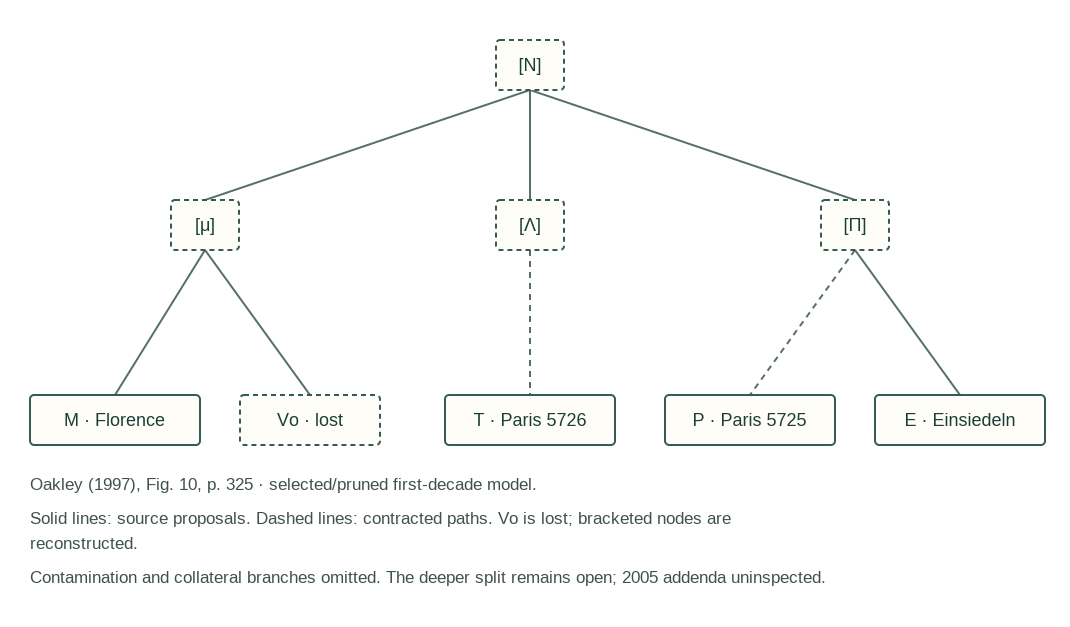
Selected/pruned historical model from Fig. 10: the N–μ/Λ/Π backbone and five named witnesses M, Vo, T, P, E. This is not a complete reproduction of the published figure, not a census, and not a new stemmatic argument.
The linked publisher-hosted bibliography corroborates Oakley’s book identity; it does not reproduce Fig. 10. The figure and surrounding discussion were inspected at the printed pages cited.
The source model
Solid lines reproduce proposed descent in Oakley’s figure; dashed lines contract the explicitly recorded paths to T and P. Dashed boxes mark reconstructed or lost nodes, distinguished by their labels. This selection omits contamination arrows and collateral branches. Manuscript nodes open their evidence cards below.
Oakley p. 156 dates M to the mid-tenth century and describes 210 folia; the official manifest labels its date 1001–1100 and format 208 cc. These attributed descriptions have not been reconciled. No normalized date or folio count is asserted in the graph. Oakley p. 156; library manifest metadata
Official IIIF manifest retrieved on 29 October 2026 (Asia/Shanghai), identifying Plut.63.19 and reporting 438 canvases. No manuscript pixels, complete coverage or legibility assessed for this packet.
Oakley 1997, p. 156; p. 325 Fig. 10; official manifest metadata, Segnatura = Plut.63.19.
Oakley reports Rhenanus’s evidence for Books I–VI and probably Gelenius’s for VII–X in the Basel Froben edition of 1535.
A historically reported lost codex, not a reconstructed ancestor and not an extant digital manuscript. No current holding repository or image link assigned.
Oakley 1997, p. 158; p. 325 Fig. 10.
manuscript
T · Paris 5726
Paris, Bibliothèque nationale de France, Latin 5726
The institutional Biblissima record binds Latin 5726 to these official BnF viewer, catalogue and manifest endpoints. This run’s direct manifest request returned HTTP 403; images and complete access were not verified.
Oakley 1997, p. 157; p. 325 Fig. 10; Biblissima record for Latin 5726 (source: Gallica).
Paris, Bibliothèque nationale de France, Latin 5725
The institutional Biblissima record binds Latin 5725 to these official BnF viewer, catalogue and manifest endpoints. This run’s direct manifest request returned HTTP 403; images and complete access were not verified.
Oakley 1997, pp. 156–157; p. 325 Fig. 10; Biblissima record for Latin 5725 (source: Gallica).
Fragmentary witness: Oakley records the preface–I.28.2 and IV.30.14–VI.36.3, not a complete surviving first decade.
Identity established from Oakley; no exact current digital object or official catalogue endpoint verified in this packet. Do not substitute a neighbouring e-codices shelfmark.
Her prose describes Oakley as adopting a tripartite stemma. This summary must not erase the explicit openness of Oakley’s own pp. 321–324, and her later simplified diagram is not silently merged into this selection.
8 source-bound relationships
Source node
Descendant node
Locator
Meaning and limits
[N]
[μ]
Oakley 1997, Fig. 10, p. 325.
A solid branch is drawn from [N] to [μ]. The unresolved relationship among μ, Π and Λ is discussed on pp. 321–324.
[N]
[Λ]
Oakley 1997, Fig. 10, p. 325.
A solid branch is drawn from [N] to [Λ]. The diagram does not settle whether Π and Λ share an additional intermediate ancestor against μ.
[N]
[Π]
Oakley 1997, Fig. 10, p. 325.
A solid branch is drawn from [N] to [Π]. Preserve the open question on pp. 321–324 rather than treating three equal branches as settled consensus.
[μ]
M · Florence
Oakley 1997, Fig. 10, p. 325.
A solid branch is drawn from [μ] to M.
[μ]
Vo · lost
Oakley 1997, Fig. 10, p. 325.
A solid branch is drawn from [μ] to Vo, which Oakley identifies as a lost manuscript on p. 158.
[Λ]
T · Paris 5726
Oakley 1997, Fig. 10, p. 325.
Pruned path: Λ reaches T through the unlabelled fork whose other arm reaches [θ]. The fork and θ branch are omitted; this is not a transcription of one uninterrupted source edge or a claim of direct copying.
[Π]
P · Paris 5725
Oakley 1997, Fig. 10, p. 325.
Pruned path: Π reaches P along the branch from which U also diverges. The unlabelled P/U junction and U branch are omitted; this is not a transcription of one uninterrupted source edge or a claim of direct copying.
[Π]
E · Einsiedeln
Oakley 1997, Fig. 10, p. 325.
A solid branch is drawn from [Π] to E. The separate correcting layer Eᶜ and subsequent descendants are omitted.