
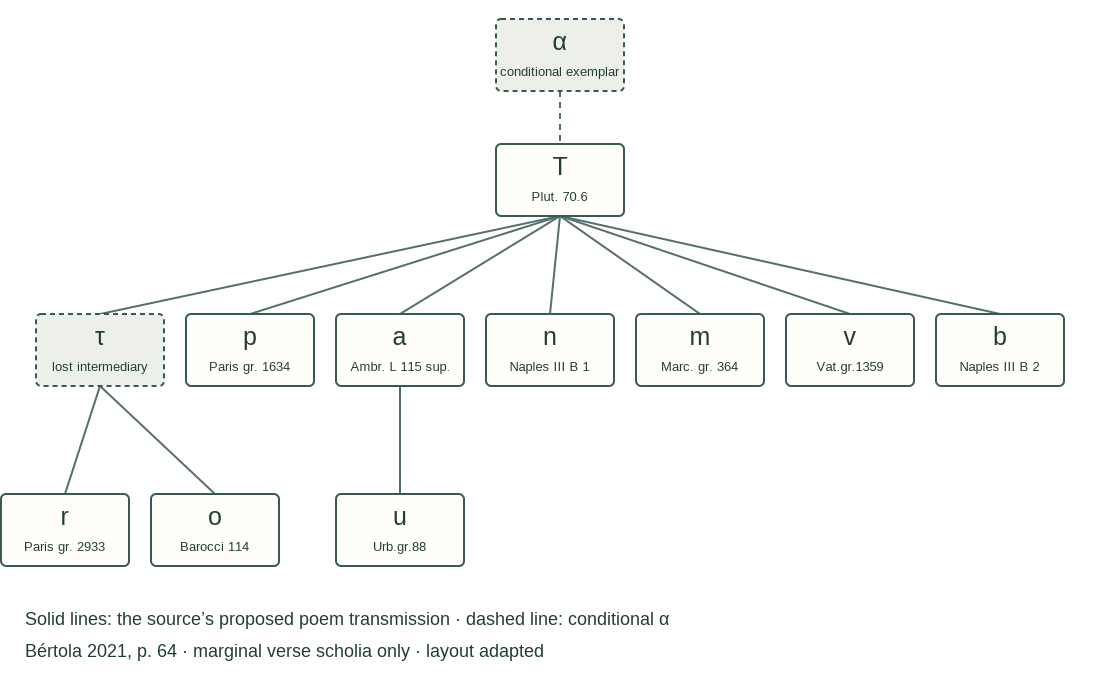
inspected source model · p. 32; pp. 61–64
The model concerns a cycle of eleven verse scholia alongside Herodotus 2.172–3.37, not the genealogy of the complete Histories.
HERODOTUS MARGINALIA · BÉRTOLA 2021
Eleven verse scholia copied beside Herodotus’ Histories have a source-specific transmission model. This diagram concerns the marginal poems, not the complete Histories.
Julián Bértola, Using poetry to read the past: unedited Byzantine verse scholia on historians in the margins of medieval manuscripts, doctoral dissertation (Ghent, 2021), Chapter 2, pp. 32, 51–52, 61–64; sigla p. 67. Institutional source record ↗ · Open dissertation PDF ↗
Diagram · Text-only witness list · Argument, dating and correction layers · Histories: Wilson guide
Click a physical witness to open its identity card. On a small screen, scroll the diagram horizontally or use the text-only list. Solid lines reproduce proposed transmission; they do not assert that every edge is an independently verified act of direct copying.
Dashed boxes mark reconstructed nodes. α is conditional on the poems not being the work of T’s scribe; τ is a different lost intermediary. The adapted layout uses a dashed α line to show the condition stated in the source’s prose, rather than reproducing its original line style.
Open or save standalone diagram · Download the source-scoped model
inspected source model · p. 32; pp. 61–64
The model concerns a cycle of eleven verse scholia alongside Herodotus 2.172–3.37, not the genealogy of the complete Histories.
source argument · pp. 61–62
Bértola proposes a as the model for u for this poem cycle, drawing on shared readings, a shared marginal note and the pattern of omitted poems.
reported scholarship · pp. 51–52, §2.4.4 and n. 84
Bértola reports that De Gregorio dates Urb.gr.88 to the third decade of the fifteenth century from its main-hand script, while rejecting identification of the scribe with Chrysokokkes himself.
reported scholarship and source observation · pp. 51–52
The description distinguishes the main copyist’s marginalia and a change of textual model around Histories 3.26 from later marginalia attributed to Palla Strozzi.
conditional reconstruction · p. 64 and n. 232
α represents a prior manuscript containing the poet’s own work only if the poems were not composed by T’s scribe, Nicholas Triklines.
All sigla belong to Bértola’s 2021 poem edition: u is the same codex as Wilson U; r is Paris grec 2933, not Wilson’s consensus r or his witness R.
Identity follows the dissertation’s sigla (p. 67); repository access has not been independently checked in this cycle.
Identity follows the dissertation’s sigla (p. 67); repository access has not been independently checked in this cycle.
Identity follows the dissertation’s sigla (p. 67); repository access has not been independently checked in this cycle.
Same physical codex: Wilson U · Checked scholarly catalogue ↗
Identity follows the dissertation’s sigla (p. 67); repository access has not been independently checked in this cycle.
Identity follows the dissertation’s sigla (p. 67); repository access has not been independently checked in this cycle.
Identity follows the dissertation’s sigla (p. 67); repository access has not been independently checked in this cycle.
Identity follows the dissertation’s sigla (p. 67); repository access has not been independently checked in this cycle.
Identity follows the dissertation’s sigla (p. 67); repository access has not been independently checked in this cycle.
Identity follows the dissertation’s sigla (p. 67); repository access has not been independently checked in this cycle.
Return to the research atlas · Histories: catalogue and dating comparison