Magalia 籬廬
AWARCHAEOLOGY WORLDField atlas · Corinth

Archaeology World · field atlas

Corinth

Terraces, civic places, sanctuaries and the making of the visible city

Read the Greek and Roman city through its terraces, springs, civic buildings, sanctuaries and later neighbourhoods.

Original explanatory reading of Temple of Apollo · plans and standing remains; not a complete site reconstruction.
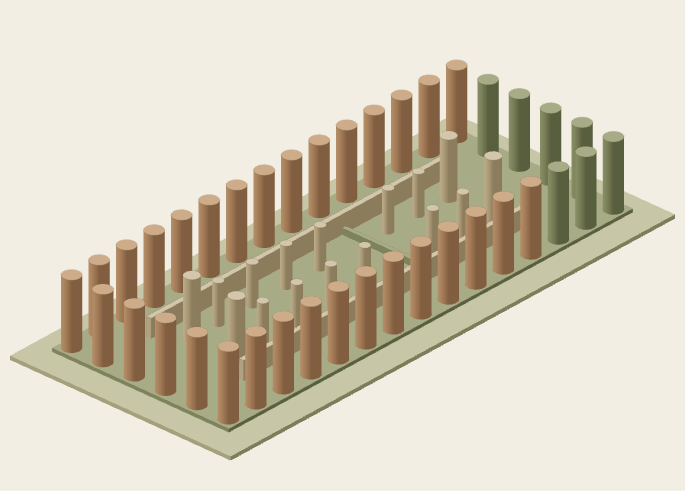
Temple of Apollo · plans and standing remains · original explanatory geometry. Reported quantities and display conventions are disclosed in the model study.

Expanded architectural atlas

4 buildings and spatial readings.

29 drawing records and 10 candidate records. Inspect new cases, filter published drawings and compare their evidence roles.

Open the architectural atlas ↗ Enter the 3D workspace ↗

Reading the place

Terraces, springs and urban histories.

Corinth becomes more intelligible when its visible monuments are placed in several overlapping histories: topography and water, civic construction, religious activity, later settlement, excavation and restoration. This study therefore moves beyond the Apollo pilot while preserving explicit differences between observed fabric, published interpretation and a resource discovered for future work.

A plan is not simply a picture of the past. Period reconstructions, excavation-state plans, historical drawings, orthophotos and geospatial adaptations document different things. The study links them as research objects and leaves uninspected images and meshes outside the reusable asset set.

The first edition is substantial but bounded. Several important later publications were accessible here only through their official author abstracts. Their arguments are identified as such, and their full texts remain priorities. No lack of access is concealed as consultation.

Study scope and consultation boundary

Independent first research edition covering central Corinth and selected connected districts. Thirty-eight checked source-bound claims; ten monument/district entries. Not a final monograph, exhaustive online-report survey or complete city reconstruction.

Read the inspection record ↙

Place history · excavation history

A site through its evidence.

Follow a chapter or read continuously. Source roles, changes in interpretation and the limits of each excavated area remain visible.

01 · research chapter

1 · A city on terraces, an excavated window

Begin with uneven archaeological visibility. The Forum is a major research window, but its exposed architecture cannot substitute for an all-period plan of Corinth. Springs, scarps and circulation connect districts without making them contemporary. Greek agora location remains a question; colonial refoundation is a historical anchor, not permission to erase intermediate activity. Read the Greek city, the Roman colony and later settlements at the scale their sources actually support.

The modern central excavation concentrates on the Forum and its surroundings, leaving a strongly selective view of the ancient city.

institutional topographical summary
ASCSA Corinth Excavations, History of Corinth · Habitation ↗

Excavated visibility is not a settlement-density map or a boundary of ancient Corinth.

Corinth was refounded as a Roman colony in 44 BCE; the earlier Greek city and later colonial landscape require separate readings.

established historical anchor
Antony J. S. Spawforth, Corinth, Argos, and the Imperial Cult: Pseudo-Julian, Letters 198, Hesperia 63 (1994), 211–232 · Spawforth 1994, p. 213 ↗Nancy Bookidis and Ronald S. Stroud, Apollo and the Archaic Temple at Corinth, Hesperia 73 (2004), 401–426 · Bookidis and Stroud 2004, pp. 413–414 ↗

Refoundation does not prove an empty century, uniform demolition, or simultaneous replacement of every district.

02 · research chapter

2 · Temple Hill: what seven columns do and do not establish

The Apollo temple is a strong architectural entry point because plan logic, standing fabric, later alterations and reconstruction debates can be separated. Its perimeter count supports a legible diagram. It does not settle disputed spacings, krepis, total elevation, cella access or Roman rearrangement. Study modern reinforcement alongside ancient building history. Keep the Apollo identification as an argued conclusion, and resist locating buildings merely from reused inscriptions found nearby.

03 · research chapter

3 · Peirene: a water biography beyond the Roman facade

Peirene should be read through overlapping architectural and hydraulic biographies. The early facade, later court, changing pools and medieval channels are distinct units. Robinson’s revision of the triconch date changes the monument’s place in urban history and challenges a familiar great-benefactor attribution. The present ruin also contains absences produced by excavation. A source-critical presentation should let users compare period readings, documentary plans and modern visibility without implying that the current arrangement is a single ancient design.

04 · research chapter

4 · Forum, Lechaion Road and South Stoa: civic space through contested deposits

Use the Roman Forum and its approaches to organise questions about movement, civic display and inherited structures; avoid making them the automatic plan of the Greek agora. The South Stoa debate demonstrates why a smooth chronology can conceal different dating units: construction activity, destruction, well filling and later room use are separate events. Temple E adds an independent warning: identity and restoration are both interpreted, and familiar names or erected fragments cannot end the investigation.

Corinth was refounded as a Roman colony in 44 BCE; the earlier Greek city and later colonial landscape require separate readings.

established historical anchor
Antony J. S. Spawforth, Corinth, Argos, and the Imperial Cult: Pseudo-Julian, Letters 198, Hesperia 63 (1994), 211–232 · Spawforth 1994, p. 213 ↗Nancy Bookidis and Ronald S. Stroud, Apollo and the Archaic Temple at Corinth, Hesperia 73 (2004), 401–426 · Bookidis and Stroud 2004, pp. 413–414 ↗

Refoundation does not prove an empty century, uniform demolition, or simultaneous replacement of every district.

05 · research chapter

5 · Theatre and Odeion: connection, conversion and historical scale

The performance district needs its own building sequence. A court connecting two structures belongs to a particular architectural stage; it should not appear in every reconstructed period. Spectacle texts, arena barriers and possible animal installations also have different evidential ranges. Historical interpretation is strongest when it exposes a mismatch between a text’s proposed date and a surviving venue’s later conversion, rather than forcing the text into the most visually attractive ruin.

Broneer treats the court linking the Odeion and Theatre as a second-period addition, with aspects of access and shape requiring further investigation.

foundational report excerpt
Oscar Broneer, The Odeum, Corinth X (1932) · p. 72, discussion of fig. 45 ↗

Only the indexed passage was inspected; the complete monograph and figure were not. Later revisions remain a required check.

06 · research chapter

6 · Demeter and Kore, Asklepios and Lerna: activities outlast labels

Move from central civic monuments to sanctuary contexts and water-related facilities. Dining rooms, votive evidence and cemetery reuse ask different questions from a temple facade. A late object in a sanctuary does not automatically prove continuation of cult; its deposition may belong to robbing or burial. Catalogue descriptions provide an orientation, while detailed ritual or architectural reconstruction must wait for the final reports and context catalogues. Preserve that gap instead of filling it with generic sacred architecture.

The Demeter and Kore architectural volume treats three sanctuary terraces and facilities for dining, cooking and bathing alongside cult structures.

institutional description of a published monument corpus
Nancy Bookidis and Ronald S. Stroud, The Sanctuary of Demeter and Kore: Topography and Architecture, Corinth XVIII.3 (1997) · Official publisher description ↗

The final volume and its twelve plans were not read; no ritual sequence or detailed geometry is inferred from catalogue metadata.

07 · research chapter

7 · Late antiquity and medieval Corinth: uneven changes, continuing investigation

The later city deserves its own evidence, rather than a closing decline paragraph. Water reuse, funerary occupation, craft production and new street/floor sequences have different spatial extents. Recent work northeast of the Theatre makes the limits of knowledge visible: a probable bath function, a possible open-air court, and an unexcavated hypocaust are not equivalent observations. Ceramic studies also complicate an equation of political conquest with immediate changes in material culture. These are separate research tracks, not a single universal abandonment horizon.

Joyner’s abstract places a cooking-ware change decades after Frankish occupation and suggests local production of both compared traditions.

author-reported petrographic interpretation; abstract inspected
Louise Joyner, Cooking Pots as Indicators of Cultural Change: A Petrographic Study of Byzantine and Frankish Cooking Wares from Corinth, Hesperia 76 (2007), 183–227 · Official abstract ↗

Pot style, political regime and population identity are distinct variables; full fabric catalogue not inspected.

Peirene reuse, sanctuary cemetery contexts and sampled medieval occupation demand separate chronologies rather than a single abandonment story.

cross-context research synthesis
Betsey A. Robinson, Histories of Peirene: A Corinthian Fountain in Three Millennia (2011), official sample · Robinson 2011, pp. 7–8 ↗Kathleen Warner Slane, The End of the Sanctuary of Demeter and Kore on Acrocorinth, Hesperia 77 (2008), 465–496 · Slane 2008, official abstract ↗Florence Liard, Guy Sanders, Ayed Ben Amara and Noemi Mueller, Lead-Glazed Pottery at Late Medieval Corinth, Hesperia 91 (2022), 485–569 · Liard et al. 2022, official abstract ↗

This does not claim uninterrupted use of every monument; cessation of cult, destruction, robbing and later settlement are different events.

08 · research chapter

8 · Excavation, restoration, plans and responsible 3D

Treat excavation and conservation as historical processes that shape what can now be seen. Compare early records with current survey and distinguish measured portions of a plan from areas supplemented from earlier drawings. Read a phase layer as a classified dataset whose source dates and interpretive choices still matter. A licensed external model can document visible remains while a newly authored cutaway explains a hypothesis; neither can silently certify the other. Future 3D work should grow monument by monument through source and geometry review.

Modern presentation can join features from different periods while the removal of later accretions obscures other histories.

research synthesis
Betsey A. Robinson, Histories of Peirene: A Corinthian Fountain in Three Millennia (2011), official sample · Robinson 2011, pp. 7–8 ↗Mary E. Hoskins Walbank, Pausanias, Octavia and Temple E at Corinth, Annual of the British School at Athens 84 (1989), 361–394 · Walbank 1989, p. 363 ↗Dimitra Andrikou, The Temple of Apollo at Corinth. Observations on the Architectural Design (2019), pp. 22–35 · Andrikou 2019, pp. 22–23 ↗

Apply this as a documented interpretive problem; do not invent missing restoration dates or original surfaces.

A record of different places

Areas & monuments.

Select an area to read its evidence and inspect its published drawings. The list describes research coverage, not an invented city plan.

01

Temple Hill and Apollo temple

Architectural pilot with strong perimeter logic, disputed interiors and explicit conservation history.

Existing original explanatory cutaway may be reused with uncertainty labels; separate official-linked textured remains model. No new metric or complete-city model admitted.

02

Lower Peirene and hydraulic system

Early facade, late-antique court, removed pool, underground galleries and medieval-modern channels must be separate evidence layers.

High-priority next 3D study after plan import, mixed survey-basis audit and documentary phase reconciliation.

03

South Stoa and room C

Long-lived civic architecture with distinct construction, well-filling and room-use questions.

Needs full James2019/Slane2022 consultation and precise phase plans before new geometry.

04

Forum and Lechaion Road

Central civic and movement context; Roman topography does not establish a Greek agora footprint.

Orientation and layered questions only; no whole-district reconstruction newly admitted.

The modern central excavation concentrates on the Forum and its surroundings, leaving a strongly selective view of the ancient city.

institutional topographical summary
ASCSA Corinth Excavations, History of Corinth · Habitation ↗

Excavated visibility is not a settlement-density map or a boundary of ancient Corinth.

Corinth was refounded as a Roman colony in 44 BCE; the earlier Greek city and later colonial landscape require separate readings.

established historical anchor
Antony J. S. Spawforth, Corinth, Argos, and the Imperial Cult: Pseudo-Julian, Letters 198, Hesperia 63 (1994), 211–232 · Spawforth 1994, p. 213 ↗Nancy Bookidis and Ronald S. Stroud, Apollo and the Archaic Temple at Corinth, Hesperia 73 (2004), 401–426 · Bookidis and Stroud 2004, pp. 413–414 ↗

Refoundation does not prove an empty century, uniform demolition, or simultaneous replacement of every district.

05

Temple E precinct

A separate sanctuary/precinct with disputed dedication and caution over visible architectural restoration.

Read full reassessments, later scholarship and current measured plan before structural reconstruction.

06

Theatre, Odeion and connecting court

Performance district with architectural links and arena conversions belonging to different stages.

Textual relation is a research lead; source plans and later field reports require full inspection before geometry.

Broneer treats the court linking the Odeion and Theatre as a second-period addition, with aspects of access and shape requiring further investigation.

foundational report excerpt
Oscar Broneer, The Odeum, Corinth X (1932) · p. 72, discussion of fig. 45 ↗

Only the indexed passage was inspected; the complete monograph and figure were not. Later revisions remain a required check.

07

Demeter and Kore sanctuary

Three terraces with religious, dining and service contexts, followed by robbing/cemetery questions.

Final-publication plan inventory discovered; no uninspected sanctuary reconstruction admitted.

The Demeter and Kore architectural volume treats three sanctuary terraces and facilities for dining, cooking and bathing alongside cult structures.

institutional description of a published monument corpus
Nancy Bookidis and Ronald S. Stroud, The Sanctuary of Demeter and Kore: Topography and Architecture, Corinth XVIII.3 (1997) · Official publisher description ↗

The final volume and its twelve plans were not read; no ritual sequence or detailed geometry is inferred from catalogue metadata.

08

Asklepieion and Lerna

Healing/votive sanctuary linked to a water court whose later funerary and church uses require their own sequence.

Official external 3D resource exists as a lead; no full mesh or monument geometry audited here.

09

Northeast of the Theatre current excavations

Marble Room, bathing rooms, Byzantine occupation and a deep mixed trench expose active chronological and functional questions.

Preliminary findings only. Obtain plan control and distinguish observed walls from unexcavated hypocaust/reconstructed elevations.

10

Frankish Area and later settlement

Material production and sampled continuity after raid must be considered separately from political labels and city-wide narratives.

No medieval street/building massing without final context plans; chronology should remain evidence-bound.

Joyner’s abstract places a cooking-ware change decades after Frankish occupation and suggests local production of both compared traditions.

author-reported petrographic interpretation; abstract inspected
Louise Joyner, Cooking Pots as Indicators of Cultural Change: A Petrographic Study of Byzantine and Frankish Cooking Wares from Corinth, Hesperia 76 (2007), 183–227 · Official abstract ↗

Pot style, political regime and population identity are distinct variables; full fabric catalogue not inspected.

Peirene reuse, sanctuary cemetery contexts and sampled medieval occupation demand separate chronologies rather than a single abandonment story.

cross-context research synthesis
Betsey A. Robinson, Histories of Peirene: A Corinthian Fountain in Three Millennia (2011), official sample · Robinson 2011, pp. 7–8 ↗Kathleen Warner Slane, The End of the Sanctuary of Demeter and Kore on Acrocorinth, Hesperia 77 (2008), 465–496 · Slane 2008, official abstract ↗Florence Liard, Guy Sanders, Ayed Ben Amara and Noemi Mueller, Lead-Glazed Pottery at Late Medieval Corinth, Hesperia 91 (2022), 485–569 · Liard et al. 2022, official abstract ↗

This does not claim uninterrupted use of every monument; cessation of cult, destruction, robbing and later settlement are different events.

Return to the field record

Plans, sections, proposals.

Excavation states, chronological reconstructions and modern conservation drawings answer different questions. Open the owning publication at the cited locator.

published reconstruction alternatives

Apollo temple: alternative cella plans

p. 32, fig. 7

Two proposals must remain alternatives; an illustration is not an as-found plan.

Source link only; no image or traced geometry admitted.

Inspect the published drawing ↗

Dimitra Andrikou, The Temple of Apollo at Corinth. Observations on the Architectural Design (2019), pp. 22–35

published period/topographic plan

Central Corinth around 150 CE

p. 403, fig. 1

Interpretive period plan; not a current excavation-state survey.

Source link only; no image or traced geometry admitted.

Inspect the published drawing ↗

Nancy Bookidis and Ronald S. Stroud, Apollo and the Archaic Temple at Corinth, Hesperia 73 (2004), 401–426

historical excavation plan and photograph

1902 excavations and approximate pinax findspot

pp. 416–417, figs. 2–3

Historical room numbering and secondary deposition must be checked before locating an ancient dedication.

Source link only; no image or traced geometry admitted.

Inspect the published drawing ↗

Nancy Bookidis and Ronald S. Stroud, Apollo and the Archaic Temple at Corinth, Hesperia 73 (2004), 401–426

published historical-period orientation plan

Central Corinth / Temple E context

p. 362, fig. 1; pp. 363 ff. discussion

source edition opening pages consulted; no plan raster or detailed temple geometry admitted.

Source link only; no image or traced geometry admitted.

Inspect the published drawing ↗

Mary E. Hoskins Walbank, Pausanias, Octavia and Temple E at Corinth, Annual of the British School at Athens 84 (1989), 361–394

foundational proposed/relational plan lead

Theatre–Odeion court relation

p. 72 discussion referring to fig. 45

Figure image not inspected; the text itself records uncertainty and the need for further work.

Source link only; no image or traced geometry admitted.

Inspect the published drawing ↗

Oscar Broneer, The Odeum, Corinth X (1932)

discovered final-publication state plan

Demeter and Kore: entire-sanctuary actual-state plan

Publisher inventory: 12 plans, including 1:100 actual-state plan

Actual plan sheets not inspected. Catalogue scale is not a registration or accuracy certificate.

Source link only; no image or traced geometry admitted.

Inspect the published drawing ↗

Nancy Bookidis and Ronald S. Stroud, The Sanctuary of Demeter and Kore: Topography and Architecture, Corinth XVIII.3 (1997)

official mixed-basis state plan

Peirene state plan

Other Data and Shapefiles: survey completed 2006

Dangerous/unsurveyed areas supplemented with Hill drawings; archive not imported.

CC BY-SA 4.0 per official page; retain James Herbst/ASCSA and layer/source distinctions.

Inspect the published drawing ↗

James Herbst / ASCSA, Maps, GIS, and archaeological data: Corinth and Greece

official adapted historical/survey plan

Peirene underground water system

Other Data and Shapefiles: Underground water system

The official page says new survey control was used to rubbersheet Hill’s older plan; original observation and transformation are distinct.

CC BY-SA 4.0 for Corinth data per official page; inspect file-specific metadata before reuse.

Inspect the published drawing ↗

James Herbst / ASCSA, Maps, GIS, and archaeological data: Corinth and Greece

official multi-layer GIS inventory

Corinth GIS archive: 19 named layers

GIS Data: Greek, Roman, Frankish; Northeast of Theater and Nezi Field state plans

Archive not imported or spatially audited; historical layers cannot be treated as exact synchronous snapshots.

CC BY-SA 4.0 for Corinth data per official page; redistributed regional sources need their own attribution.

Inspect the published drawing ↗

James Herbst / ASCSA, Maps, GIS, and archaeological data: Corinth and Greece

campaign orthophoto / architectural field evidence

Northeast of Theatre after the 2025 season

Excavations Northeast of the Theater, fig. 1: orthophoto by J. Herbst

Caption/text inspected; pixels not digitized. Campaign exposure is not a complete city or phase plan.

Source link only; no image or traced geometry admitted.

Inspect the published drawing ↗

Christopher Pfaff, Corinth Excavations 2025: Excavations Northeast of the Theater

Source figure pixels are linked; public availability alone does not establish a licence to redistribute them. The original model plan is available inside the architecture study.

Plan, mass and uncertainty

Turn the drawing.
Inspect its assumptions.

Temple of Apollo · plans and standing remains

Use orbit, axonometric, plan and section views; select features and read their claims. Download the original plan diagram, evidence ledger or annotated GLB model.

Open the independent architecture study ↗
Qualified original monument reading
A bounded monument reading within this wider site study. No whole-city reconstruction is asserted.

Interpretation is an argument

Questions that remain open.

Keep alternative explanations and source-era differences available for inspection.

Which South Stoa event is being dated?

An east-end construction deposit, well fills, destruction and later room use date different activities. The inspected author abstracts disclose disagreement; full contextual arguments are still required for resolution.

Evidence co2-C16 ↙

Evidence co2-C17 ↙

Evidence co2-C18 ↙

Political labels and material culture

Petrographic production claims and a delayed cooking-ware change cannot be reduced to a map of ethnic populations or an instant material replacement after conquest.

Evidence co2-C27 ↙

Evidence co2-C28 ↙

Consultation is part of the record

Research records.

22 source records in this independent study. Each discloses what was actually inspected. Catalogue discovery does not imply full reading.

Inspected for this edition

  • Actual Robinson2011 official sample, selected introduction/chapter1/chapter3 sections
  • Actual Andrikou2019 acquired text rechecked
  • Actual Bookidis/Stroud2004 archaeological-evidence section re-opened
  • Walbank 1989, opening pp. 361–363
  • Actual Spawforth1994 selected sections and indexed1995correction
  • Actual2025official campaign report text, four areas and caveats
  • Official author abstracts for James2019, Slane2008/2022, Joyner2007, Liardet al.2022
  • Official monograph catalogue descriptions, GIS page, model page and Metis access structure

Uninspected and unresolved

  • Full James2019 and Slane2022 SouthStoa arguments, deposits and well catalogues
  • Full Demeter/Kore1997architecture and Slane2008context catalogue
  • Full Roebuck1951Asklepieion/Lerna volume
  • Full Broneer1932Odeum and Stillwell1952Theatre volumes
  • Romano1994interim-period deposit body
  • Full Frankish1991–1997 reports and Liard2022/Joyner2007catalogues
  • Full Corinth2022–2023 Hesperia94(2025),537–617 report; current2025websummary is a different publication
  • Every Greek Archaeological Service/rescue report, regional survey and harbour publication

Limits and access failures

  • Selected districts, not all Corinth/Corinthia.
  • Author abstract, institutional catalogue and full-body consultation are separately marked.
  • No new raster, mesh, terrain, measured city model or complete abandonment chronology admitted.
  • Earlier 49-volume/8-report discovery inventory is not a consulted-work count.
  • Publicly accessible files are not automatically reusable derivative assets.
  • 2024campaign web PDF returned502; no claims derived from unseen body.
  • Odeum fullPDF rejected for30.9MB size; only indexedp72passage read.
  • Several primaryHesperiaPDFs and article pages timed out or returned502; indexedabstract/discovery limits retained.
  • Full Frankish1991PDF exceeded webtoolsize limit; it remains unread.

Published monument biography and critical excavation history

Betsey A. Robinson, Histories of Peirene: A Corinthian Fountain in Three Millennia (2011), official sample ↗

Introduction pp. xx–xxiv; chapter 1, pp. 4–11; chapter 3, pp. 70–80

Inspection: Actual official sample text inspected online, concentrating on the named printed sections. The sample includes selected chapters, not the whole book. Later chapter arguments, complete notes and every illustrated plate were not independently read.

Reuse: Copyright retained by the named publication/project. External reference only; no report raster, traced plan or mesh redistributed.

Published architectural observations and explicit reconstruction proposals

Dimitra Andrikou, The Temple of Apollo at Corinth. Observations on the Architectural Design (2019), pp. 22–35 ↗

pp. 22–27, 29–32; figs. 1–3 and 7

Inspection: Previously acquired complete PDF and extracted text rechecked for this study. Selected figure evidence was already visually inspected in the pilot; no new complete independent assessment of every architectural proposal.

Reuse: Copyright retained by the named publication/project. External reference only; no report raster, traced plan or mesh redistributed.

Published identification argument and archaeological critique

Nancy Bookidis and Ronald S. Stroud, Apollo and the Archaic Temple at Corinth, Hesperia 73 (2004), 401–426 ↗

pp. 401–404, 408, 411–417

Inspection: Official PDF text re-opened for archaeological evidence, pp. 411–412; identification and plan-context passages also inspected in this conversation. Full bibliography and all ancient textual arguments not independently audited.

Reuse: Copyright retained by the named publication/project. External reference only; no report raster, traced plan or mesh redistributed.

Institutional site-history overview

ASCSA Corinth Excavations, History of Corinth ↗

Location; Habitation; Classical and Hellenistic Corinth; Roman Corinth

Inspection: Official HTML re-opened and relevant sections read. This broad modern synthesis is not used to override more specific revised monument studies.

Reuse: Copyright retained by the named publication/project. External reference only; no report raster, traced plan or mesh redistributed.

Author abstract reporting results of 2015 excavation; limited consultation

Sarah A. James, The South Stoa at Corinth: New Evidence and Interpretations, Hesperia 88 (2019), 155–214 ↗

Official author abstract; article range 155–214

Inspection: Official indexed author abstract inspected. Direct page retrieval subsequently timed out. Full article, construction deposits, plans and room-C stratigraphy were NOT read.

Reuse: Copyright retained by the named publication/project. External reference only; no report raster, traced plan or mesh redistributed.

Author abstract stating a revised stratigraphic argument; not a settled consensus

Kathleen Warner Slane, The South Stoa at Corinth and Its Wells, Hesperia 91 (2022), 385–483 ↗

Official author abstract; article range 385–483

Inspection: Official indexed abstract and ASCSA issue announcement inspected. Full text and well catalogues not consulted; direct article-page request timed out.

Reuse: Copyright retained by the named publication/project. External reference only; no report raster, traced plan or mesh redistributed.

Published reassessment; author explicitly presents Capitolium identification as a hypothesis

Mary E. Hoskins Walbank, Pausanias, Octavia and Temple E at Corinth, Annual of the British School at Athens 84 (1989), 361–394 ↗

pp. 361–363; fig. 1 on p. 362

Inspection: Actual existing source edition text extracted; opening argument and pp. 361–363 read. Full later architectural/numismatic discussion and subsequent scholarship not systematically reviewed. JSTOR record reached, not used to imply online full-text access.

Reuse: Copyright retained by the named publication/project. External reference only; no report raster, traced plan or mesh redistributed.

Foundational report excerpt; restricted evidence for a relational plan question

Oscar Broneer, The Odeum, Corinth X (1932) ↗

p. 72 discussion of second-period court and fig. 45

Inspection: Only the publicly indexed printed p. 72 passage was inspected. Complete direct PDF fetch was rejected at 30.9 MB. Full monograph and the figure image were NOT consulted.

Reuse: Official ASCSA out-of-print book PDF policy is CC BY-NC-ND; no cropped/traced figure or derived geometry supplied.

Published historical analysis distinguishing literary date from archaeological venue phases

Antony J. S. Spawforth, Corinth, Argos, and the Imperial Cult: Pseudo-Julian, Letters 198, Hesperia 63 (1994), 211–232 ↗

pp. 211–213 and 217–218

Inspection: Actual official PDF text inspected in the opening argument and performance-venue discussion. Wider imperial-cult reconstruction not adopted; a later correction is separately registered.

Reuse: Copyright retained by the named publication/project. External reference only; no report raster, traced plan or mesh redistributed.

Institutional publication description and plan discovery, not full-volume consultation

Nancy Bookidis and Ronald S. Stroud, The Sanctuary of Demeter and Kore: Topography and Architecture, Corinth XVIII.3 (1997) ↗

Official publisher description; 12-plan inventory including 1:100 actual-state plan

Inspection: Official publisher record opened and read. The 536-page volume and its plans were NOT consulted.

Reuse: Copyright retained by the named publication/project. External reference only; no report raster, traced plan or mesh redistributed.

Author abstract reporting context-sensitive reassessment of cult cessation

Kathleen Warner Slane, The End of the Sanctuary of Demeter and Kore on Acrocorinth, Hesperia 77 (2008), 465–496 ↗

Official author abstract; article range 465–496

Inspection: Official indexed abstract read; direct page requests timed out. Full context catalogue and ceramic arguments not independently inspected.

Reuse: Copyright retained by the named publication/project. External reference only; no report raster, traced plan or mesh redistributed.

Monograph catalogue and institutional summary of sanctuary and votives

Carl Roebuck, The Asklepieion and Lerna, Corinth XIV (1951) ↗

Official publisher description; 5-map inventory

Inspection: Official publisher description read. Full monograph and map images not consulted.

Reuse: Copyright retained by the named publication/project. External reference only; no report raster, traced plan or mesh redistributed.

Institutional catalogue overview, distinct from final excavation argument

ASCSA Metis, Asklepieion monument overview ↗

Overview: Lerna Court, disuse, cemetery and chapel paragraphs

Inspection: Public indexed official record text inspected; no underlying context records or excavation notebooks read.

Reuse: Copyright retained by the named publication/project. External reference only; no report raster, traced plan or mesh redistributed.

Author abstract; spatially bounded medieval craft/occupation interpretation

Florence Liard, Guy Sanders, Ayed Ben Amara and Noemi Mueller, Lead-Glazed Pottery at Late Medieval Corinth, Hesperia 91 (2022), 485–569 ↗

Official author abstract; article range 485–569

Inspection: Official indexed author abstract and ASCSA publication announcement inspected. All 97 analyses, full stratigraphy and distributions NOT read; direct article-page fetch returned 502.

Reuse: Copyright retained by the named publication/project. External reference only; no report raster, traced plan or mesh redistributed.

Author abstract; production/provenance inference rather than an ethnic map

Louise Joyner, Cooking Pots as Indicators of Cultural Change: A Petrographic Study of Byzantine and Frankish Cooking Wares from Corinth, Hesperia 76 (2007), 183–227 ↗

Official author abstract; article range 183–227

Inspection: Official indexed abstract read. Full petrographic catalogue and sampled contexts not consulted.

Reuse: Copyright retained by the named publication/project. External reference only; no report raster, traced plan or mesh redistributed.

Preliminary excavation report for one campaign, with explicit tentative functions

Christopher Pfaff, Corinth Excavations 2025: Excavations Northeast of the Theater ↗

Unpaginated web report: Excavations Northeast of the Theater; figs. 1–5 and adjoining text

Inspection: Actual official web-report text read for all four excavation areas and caveats. The document is not cited by scan/container page numbers. Figures were identified from captions, not visually digitized or licensed for reuse.

Reuse: Copyright retained by the named publication/project. External reference only; no report raster, traced plan or mesh redistributed.

Current official geospatial access and provenance statement

James Herbst / ASCSA, Maps, GIS, and archaeological data: Corinth and Greece ↗

GIS Data: 19-layer list; Other Data and Shapefiles: Peirene state plan and underground water system

Inspection: Official page and linked records checked. Archive contents were not consulted or spatially audited.

Reuse: Official page licenses Corinth archaeological data/basemaps CC BY-SA 4.0. Preserve individual source/layer metadata and adaptation notices; regional redistributed datasets have separate source roles.

External textured standing-remains model, separate from an explanatory reconstruction

James Herbst, Temple Of Apollo at Corinth, official ASCSA-linked model (2020) ↗

Official ASCSA 3D page; Sketchfab model UID da12db140004405d96388f8948ab2cd1

Inspection: Official ASCSA model page re-opened; API metadata re-requested for this study. No full mesh inspection or survey calibration.

Reuse: CC BY 4.0 reported by live model API; credit jamesherbst / James Herbst. Downloadable flag does not establish original survey precision.

Archive structure, access and corpus-boundary guidance

ASCSA, About Metis: ASCSA Archaeological Platform ↗

Access statement; data types: Stratigraphic Units, Spatial Documents, Media, Publications

Inspection: Official indexed description and access distinction rechecked. No privileged archive access attempted.

Reuse: Research/teaching access is not a blanket image/model republication licence.

Publication discovery, not source-body consultation

ASCSA, Corinth series catalogue and current-excavation index ↗

Series entries; current campaigns indexed separately at official Current Excavation page

Inspection: Official catalogue results inspected; the earlier bounded 49-volume/8-report inventory is a discovery aid, not a count of consulted works.

Reuse: Copyright retained by the named publication/project. External reference only; no report raster, traced plan or mesh redistributed.

Primary report discovery for a major historical debate

Irene B. Romano, A Hellenistic Deposit from Corinth: Evidence for Interim Period Activity (146–44 B.C.), Hesperia 63 (1994), 57–104 ↗

Article title and official issue record; printed range 57–104

Inspection: Publication identity verified, but full direct PDF request timed out. Deposit body NOT consulted; retained as mandatory next reading rather than proof of the scale of occupation.

Reuse: Copyright retained by the named publication/project. External reference only; no report raster, traced plan or mesh redistributed.

Complete claim ledger · 38 records

The modern central excavation concentrates on the Forum and its surroundings, leaving a strongly selective view of the ancient city.

institutional topographical summary
ASCSA Corinth Excavations, History of Corinth · Habitation ↗

Excavated visibility is not a settlement-density map or a boundary of ancient Corinth.

Corinth was refounded as a Roman colony in 44 BCE; the earlier Greek city and later colonial landscape require separate readings.

established historical anchor
Antony J. S. Spawforth, Corinth, Argos, and the Imperial Cult: Pseudo-Julian, Letters 198, Hesperia 63 (1994), 211–232 · Spawforth 1994, p. 213 ↗Nancy Bookidis and Ronald S. Stroud, Apollo and the Archaic Temple at Corinth, Hesperia 73 (2004), 401–426 · Bookidis and Stroud 2004, pp. 413–414 ↗

Refoundation does not prove an empty century, uniform demolition, or simultaneous replacement of every district.

Broneer treats the court linking the Odeion and Theatre as a second-period addition, with aspects of access and shape requiring further investigation.

foundational report excerpt
Oscar Broneer, The Odeum, Corinth X (1932) · p. 72, discussion of fig. 45 ↗

Only the indexed passage was inspected; the complete monograph and figure were not. Later revisions remain a required check.

The Demeter and Kore architectural volume treats three sanctuary terraces and facilities for dining, cooking and bathing alongside cult structures.

institutional description of a published monument corpus
Nancy Bookidis and Ronald S. Stroud, The Sanctuary of Demeter and Kore: Topography and Architecture, Corinth XVIII.3 (1997) · Official publisher description ↗

The final volume and its twelve plans were not read; no ritual sequence or detailed geometry is inferred from catalogue metadata.

Joyner’s abstract places a cooking-ware change decades after Frankish occupation and suggests local production of both compared traditions.

author-reported petrographic interpretation; abstract inspected
Louise Joyner, Cooking Pots as Indicators of Cultural Change: A Petrographic Study of Byzantine and Frankish Cooking Wares from Corinth, Hesperia 76 (2007), 183–227 · Official abstract ↗

Pot style, political regime and population identity are distinct variables; full fabric catalogue not inspected.

Peirene reuse, sanctuary cemetery contexts and sampled medieval occupation demand separate chronologies rather than a single abandonment story.

cross-context research synthesis
Betsey A. Robinson, Histories of Peirene: A Corinthian Fountain in Three Millennia (2011), official sample · Robinson 2011, pp. 7–8 ↗Kathleen Warner Slane, The End of the Sanctuary of Demeter and Kore on Acrocorinth, Hesperia 77 (2008), 465–496 · Slane 2008, official abstract ↗Florence Liard, Guy Sanders, Ayed Ben Amara and Noemi Mueller, Lead-Glazed Pottery at Late Medieval Corinth, Hesperia 91 (2022), 485–569 · Liard et al. 2022, official abstract ↗

This does not claim uninterrupted use of every monument; cessation of cult, destruction, robbing and later settlement are different events.

Bibliography and further research
  • {"sourceId": "co2-peirene", "title": "Betsey A. Robinson, Histories of Peirene: A Corinthian Fountain in Three Millennia (2011), official sample", "url": "https://www.ascsa.edu.gr/uploads/media/Histories_of_Peirene_Sample.pdf", "consultation": "Actual official sample text inspected online, concentrating on the named printed sections. The sample includes selected chapters, not the whole book. Later chapter arguments, complete notes and every illustrated plate were not independently read."}
  • {"sourceId": "co2-andrikou", "title": "Dimitra Andrikou, The Temple of Apollo at Corinth. Observations on the Architectural Design (2019), pp. 22–35", "url": "https://eclass.uoa.gr/modules/document/file.php/DI358/DHMOSIEYSH_4_ANDRIKOU_The_Temple_of_Apollo_at_Corinth_Observations_on_the_Architecture_Design.pdf", "consultation": "Previously acquired complete PDF and extracted text rechecked for this study. Selected figure evidence was already visually inspected in the pilot; no new complete independent assessment of every architectural proposal."}
  • {"sourceId": "co2-apollo-2004", "title": "Nancy Bookidis and Ronald S. Stroud, Apollo and the Archaic Temple at Corinth, Hesperia 73 (2004), 401–426", "url": "https://www.ascsa.edu.gr/uploads/media/hesperia/4134886.pdf", "consultation": "Official PDF text re-opened for archaeological evidence, pp. 411–412; identification and plan-context passages also inspected in this conversation. Full bibliography and all ancient textual arguments not independently audited."}
  • {"sourceId": "co2-history", "title": "ASCSA Corinth Excavations, History of Corinth", "url": "https://www.ascsa.edu.gr/excavations/ancient-corinth/about-the-excavations-1/history-timeline", "consultation": "Official HTML re-opened and relevant sections read. This broad modern synthesis is not used to override more specific revised monument studies."}
  • {"sourceId": "co2-james-2019", "title": "Sarah A. James, The South Stoa at Corinth: New Evidence and Interpretations, Hesperia 88 (2019), 155–214", "url": "https://www.ascsa.edu.gr/publications/hesperia/article/88/1/155-214", "consultation": "Official indexed author abstract inspected. Direct page retrieval subsequently timed out. Full article, construction deposits, plans and room-C stratigraphy were NOT read."}
  • {"sourceId": "co2-slane-2022", "title": "Kathleen Warner Slane, The South Stoa at Corinth and Its Wells, Hesperia 91 (2022), 385–483", "url": "https://www.ascsa.edu.gr/publications/hesperia/article/91/3/385-483", "consultation": "Official indexed abstract and ASCSA issue announcement inspected. Full text and well catalogues not consulted; direct article-page request timed out."}
  • {"sourceId": "co2-walbank-1989", "title": "Mary E. Hoskins Walbank, Pausanias, Octavia and Temple E at Corinth, Annual of the British School at Athens 84 (1989), 361–394", "url": "https://www.jstor.org/stable/30104565", "consultation": "Actual existing source edition text extracted; opening argument and pp. 361–363 read. Full later architectural/numismatic discussion and subsequent scholarship not systematically reviewed. JSTOR record reached, not used to imply online full-text access."}
  • {"sourceId": "co2-broneer-1932", "title": "Oscar Broneer, The Odeum, Corinth X (1932)", "url": "https://www.ascsa.edu.gr/uploads/media/oa_ebooks/oa_corinth/Corinth_X.pdf", "consultation": "Only the publicly indexed printed p. 72 passage was inspected. Complete direct PDF fetch was rejected at 30.9 MB. Full monograph and the figure image were NOT consulted."}
  • {"sourceId": "co2-spawforth-1994", "title": "Antony J. S. Spawforth, Corinth, Argos, and the Imperial Cult: Pseudo-Julian, Letters 198, Hesperia 63 (1994), 211–232", "url": "https://www.ascsa.edu.gr/uploads/media/hesperia/148112.pdf", "consultation": "Actual official PDF text inspected in the opening argument and performance-venue discussion. Wider imperial-cult reconstruction not adopted; a later correction is separately registered."}
  • {"sourceId": "co2-spawforth-correction", "title": "Antony J. Spawforth, C. Iulius Spartiaticus, “First of the Achaeans”: A Correction, Hesperia 64 (1995), 225", "url": "https://www.ascsa.edu.gr/uploads/media/hesperia/148055.pdf", "consultation": "Complete indexed correction text inspected; direct PDF fetch returned 502. It corrects the interpretation of primo Achaeon in the earlier article."}
  • {"sourceId": "co2-demeter-architecture", "title": "Nancy Bookidis and Ronald S. Stroud, The Sanctuary of Demeter and Kore: Topography and Architecture, Corinth XVIII.3 (1997)", "url": "https://www.ascsa.edu.gr/publications/book/?i=9780876611838", "consultation": "Official publisher record opened and read. The 536-page volume and its plans were NOT consulted."}
  • {"sourceId": "co2-slane-2008", "title": "Kathleen Warner Slane, The End of the Sanctuary of Demeter and Kore on Acrocorinth, Hesperia 77 (2008), 465–496", "url": "https://www.ascsa.edu.gr/publications/hesperia/article/77/3/465-496", "consultation": "Official indexed abstract read; direct page requests timed out. Full context catalogue and ceramic arguments not independently inspected."}
  • {"sourceId": "co2-asklepieion-book", "title": "Carl Roebuck, The Asklepieion and Lerna, Corinth XIV (1951)", "url": "https://www.ascsa.edu.gr/publications/book/?i=9780876611418", "consultation": "Official publisher description read. Full monograph and map images not consulted."}
  • {"sourceId": "co2-lerna-record", "title": "ASCSA Metis, Asklepieion monument overview", "url": "https://metis.ascsa.edu.gr/resource/285f5ab5c3b4299bba0381aedb1f5dbc?image_id=efaf21f6d32782cebadde3ba82f46ef6&tab=overview&view=preview", "consultation": "Public indexed official record text inspected; no underlying context records or excavation notebooks read."}
  • {"sourceId": "co2-liard-2022", "title": "Florence Liard, Guy Sanders, Ayed Ben Amara and Noemi Mueller, Lead-Glazed Pottery at Late Medieval Corinth, Hesperia 91 (2022), 485–569", "url": "https://www.ascsa.edu.gr/publications/hesperia/article/91/3/485-569", "consultation": "Official indexed author abstract and ASCSA publication announcement inspected. All 97 analyses, full stratigraphy and distributions NOT read; direct article-page fetch returned 502."}
  • {"sourceId": "co2-joyner-2007", "title": "Louise Joyner, Cooking Pots as Indicators of Cultural Change: A Petrographic Study of Byzantine and Frankish Cooking Wares from Corinth, Hesperia 76 (2007), 183–227", "url": "https://www.ascsa.edu.gr/publications/hesperia/article/76/1/183-227", "consultation": "Official indexed abstract read. Full petrographic catalogue and sampled contexts not consulted."}
  • {"sourceId": "co2-pfaff-2025", "title": "Christopher Pfaff, Corinth Excavations 2025: Excavations Northeast of the Theater", "url": "https://www.ascsa.edu.gr/uploads/general/Corinth_Report_2025_for_Web.pdf", "consultation": "Actual official web-report text read for all four excavation areas and caveats. The document is not cited by scan/container page numbers. Figures were identified from captions, not visually digitized or licensed for reuse."}
  • {"sourceId": "co2-gis", "title": "James Herbst / ASCSA, Maps, GIS, and archaeological data: Corinth and Greece", "url": "https://www.ascsa.edu.gr/excavations/ancient-corinth/digital-corinth/maps-gis-data-and-archaeological-data-for-corinth-and-greece", "consultation": "Official page and linked records checked. Archive contents were not consulted or spatially audited."}
  • {"sourceId": "co2-model", "title": "James Herbst, Temple Of Apollo at Corinth, official ASCSA-linked model (2020)", "url": "https://sketchfab.com/3d-models/temple-of-apollo-at-corinth-da12db140004405d96388f8948ab2cd1", "consultation": "Official ASCSA model page re-opened; API metadata re-requested for this study. No full mesh inspection or survey calibration."}
  • {"sourceId": "co2-metis-policy", "title": "ASCSA, About Metis: ASCSA Archaeological Platform", "url": "https://www.ascsa.edu.gr/excavations/ancient-corinth/digital-corinth/about-metis-ascsa-archaeological-database", "consultation": "Official indexed description and access distinction rechecked. No privileged archive access attempted."}
  • {"sourceId": "co2-series", "title": "ASCSA, Corinth series catalogue and current-excavation index", "url": "https://www.ascsa.edu.gr/publications/browse-by-series/corinth", "consultation": "Official catalogue results inspected; the earlier bounded 49-volume/8-report inventory is a discovery aid, not a count of consulted works."}
  • {"sourceId": "co2-romano-1994", "title": "Irene B. Romano, A Hellenistic Deposit from Corinth: Evidence for Interim Period Activity (146–44 B.C.), Hesperia 63 (1994), 57–104", "url": "https://www.ascsa.edu.gr/uploads/media/hesperia/148242.pdf", "consultation": "Publication identity verified, but full direct PDF request timed out. Deposit body NOT consulted; retained as mandatory next reading rather than proof of the scale of occupation."}

Next research priorities

  • Import official Peirene plan with original-survey versus Hill-supplemented geometry retained as separate layers; check CRS, dates and transforms.
  • Read James2019 and Slane2022 in full, map dated contexts and distinguish construction from well filling.
  • Consult complete Theatre/Odeum reports plus1980s/2011revisions before modelling connected court or arena changes.
  • Inspect Demeter/Kore actual-state plan, dining-room phase plans and cult-cessation context catalogue; retain cemetery/robbing distinctions.
  • Reconcile modern TempleE attribution and restoration studies before assigning dedication or elevating the erected fragments.
  • Build district-specific late-antique/medieval sequences, starting with northeastern campaigns and Frankish craft contexts, without a single collapse narrative.
  • Complete a source/rights/geometry review before extracting licensed GIS derivatives or rendering any new monument.

Read or save the research text ↗ · Download the complete independent study register ↗ · Model evidence and parameters ↗ · Edition manifest ↗

Your working question

A research notebook.

Save claims as you read. Notes stay in this browser under this study’s own key.

No claims saved yet.