
Architecture · Column capitals
Abacus 柱头顶板
ἄβαξ abacus
Read this entry in the Architecture Reference Edition 在建筑参考版中阅读此词条
English
The abacus is the uppermost member of a column’s capital, immediately below the architrave.
In a Doric capital, its square slab rests above the curved moulding called the echinus. The highlighted slab in the diagram shows this architectural sense of the word.1, 2
Its form varies with the order. Vitruvius describes the Corinthian abacus with sides curved inward between the corners, and sets its thickness at one seventh of the capital’s height. This ratio belongs to his prescription for a Corinthian capital.3
The same word also names objects such as counting boards, game boards and display tables in ancient texts. Identifying an architectural abacus therefore requires the context of a capital or column.1
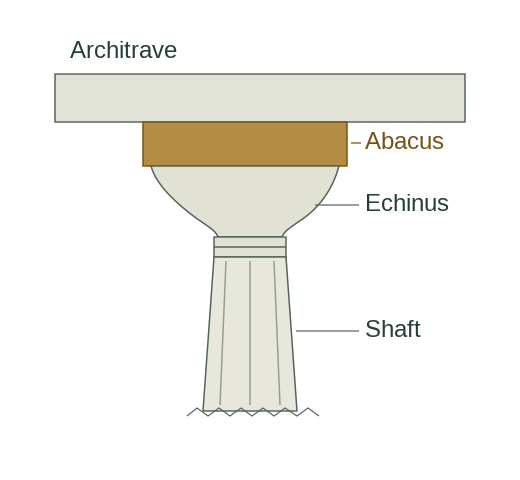
多立克柱头 · 示意图,不按比例
简体中文
顶板(abacus)是柱头最上部的构件,紧接在额枋下方。
在多立克柱头中,方形顶板位于称为 echinus 的曲面线脚之上。图中着色的板状构件表示该词的这一建筑学含义。1、2
顶板的形状因柱式而异。维特鲁威描述科林斯柱头的顶板时,规定其各边在角部之间向内凹曲,厚度为柱头高度的七分之一。这一比例属于他对科林斯柱头的设计规定。3
古代文本也用同一个词指称计数板、棋盘和陈列器皿的桌子等物。因此,要将其辨识为建筑构件,须结合柱头或柱子的语境。1
Vitruvius · De architectura 4.1.11
Latin
abaci crassitudo septima capituli altitudinis.
English
The thickness of the abacus is one seventh of the height of the capital.
简体中文
顶板的厚度为柱头高度的七分之一。